Players Sport & Social Group
Official rules for every soccer format we play, outdoor and indoor, from 11v11 down to 5v5 futsal.
All players must be listed on the team roster AND must accept & sign the online waiver to be allowed to play. Captains can edit their roster by logging in at https://www.playerssports.net/login and clicking "Manage My Team." Once listed on the roster, all players can log in to sign the waiver at https://www.playerssports.net/player/waiver.
Normal rules and penalties of FIFA apply unless exceptions have been made herein.
Men’s
Each team shall field 11 players on the field at one time. PSSG rules allow a team to play a legal game shorthanded with a minimum of 7 players. Teams may have as many players on their roster as they want. All rosters must be finalized by the second week of the regular season. Players added after the second week that are not on the team roster or waiver will not be eligible for playoffs. Players may only be on one roster per league.
During the regular season a game will be considered played in full when the second half starts. No games will be rescheduled for weather or for any other reasons once the second half starts in any game.
Coed
Each team shall field 11 players on the field at one time (no more than 7 men). PSSG rules allow a team to play a legal game shorthanded with a minimum of 7 players, with at least 2 females. Teams may have as many players on their roster as they want. There is no maximum limit on the amount of females on the field at one time. All rosters must be finalized by the second week of the regular season. Players may only be on one roster per league.
During the regular season it is ok for team captains to ask players from other teams to “Sub or Fill In” open slots on game day, to avoid forfeit. In the playoffs, a player can only participate and play for one team. If a player is found playing on two or more teams in the playoffs all games are subject to forfeit. Players must play in a minimum of one regular season game to be eligible for playoffs.
Shin-guards are strongly recommended. We also require matching colored shirts. We can supply them, but if you have jerseys let us know.
Referees will check for dangerous equipment; the referee's opinion is final. Players will not be allowed to enter play until correction has been made.
Teams will have until 10 minutes past the designated start time to field a legal team. Shorthanded teams may play a legal game with a minimum of 7 players, with at least 2 of them being females for Coed. Teams fielding less than 7 players or without at least 2 women (coed) will receive a forfeit.
Exception: Teams may play a “legal game” with less than 7 players or less than 2 females (coed) with the opposing team's consent. Teams who agree to play under these conditions will lose the option of receiving a forfeit win. Teams may pick up players during the regular season in order to field a full team. Substitutes will not be allowed during playoffs.
If your team forfeits a match during the season, the following rules apply:
First Offense: Game recorded as loss and warning issued.
Second Offense: Game recorded as loss and PSSG staff reserves the right to remove team from league and playoffs with no refund for games not played.
Third Offense: Removal from the league and playoffs with no refund for games not played.
If you know in advance that your team is going to forfeit a game, we encourage you to call our office (773.528.1999) so as to help us schedule your opponent a game. However, this does not mean that your team will not receive the loss as a forfeit.
Coin Flip: The beginning of the game will start with the PSG staff using an “odd/even”, or coin flip. The winning team will choose a goal to defend and the loser will kick-off.
Kickoff: Consists of the ball being placed at midfield on the center spot. The ball is in play once it is touched forward by any player.
Teams may not substitute “on the fly”. All substitute players must notify the referee before entering the game. Substitutions may occur during the following instances:
Players involved in an illegal substitution are subject to a caution (yellow card) if the referee deems necessary. If a team is currently playing a game shorthanded and has a player arrive late, the entering player must receive permission from the referee before entering the field and may not enter during play.
The referee has the right to deny permission to teams wishing to substitute on the other team's throw-ins if he/she believes that the substitution is for time wasting purposes, or if stopping play will deny the other team a direct chance at scoring. There is no limit on the amount of substitutions per team/per game.
During the course of the regular season teams are allowed to “pick up” players that are not on their roster in order to field a full team. In playoffs no non-roster players will be allowed to play.
There will be a running clock maintained by the referee. The clock will stop only during serious injury time-outs. Any delay tactics (kicking the ball far out of bounds) will allow the referee (at his/her discretion) to stop the clock. If time wasting is being employed by a team, the offending player may be cautioned (yellow card), at the referee's discretion.
A game will be considered played in full when the second half starts. No games will be rescheduled for weather or for any other reasons once the second half starts in any game.
Direct Kicks
The ball is to be placed at the point of the infraction and to be put in play by any player on the affected team. No opposing player is allowed to be within 10 paces/yards of the ball prior to the kick. A player stepping unnecessarily close in front of an opposing free kick may be cautioned; however, 10 paces/yards will only be granted if asked for by a member of the team with the free kick. Goals may be scored on direct kicks.
A direct kick will occur when a player commits the following "penal" fouls:
Penal fouls committed inside the penalty area by the defense will result in a penalty kick 12 paces/yards out. All players on the field (other than the goalie) must be behind the ball and outside of the penalty area until it is kicked. The goalie must remain on the goal line until the ball is kicked.
Obvious Scoring Opportunity
If a player commits a foul to take away an obvious scoring opportunity, the player should be cautioned or sent off. If in the opinion of the referee the foul was not intentional, he may yellow card the player. If a player commits an intentional foul to prevent an obvious goal scoring opportunity he may be sent off.
Indirect Kicks
The ball is to be placed at the point of the infraction and to be put in play by any player on the affected team. No opposing player is allowed to be within 10 paces/yards of the ball prior to the kick. A player stepping unnecessarily close in front of an opposing free kick may be cautioned; however, 10 paces/yards will only be granted if asked for by a member of the team with the free kick. An indirect free kick must be touched by a player (of either team) other than the person who takes the kick before a goal is scored.
Indirect kicks will occur when the goalkeeper:
Indirect kicks will occur when any player:
It is not an offence in itself to be in an offsides position.
A player is in an offsides position if:
A player is not in an offsides position if:
A player in an offsides position is only penalized if, at the moment the ball touches or is played by one of his/her teammates, he/she is, in the opinion of the referee, involved in active play by:
A player cannot be deemed offside by receiving a pass directly from a:
Anytime the ball goes completely over either sideline, out of bounds, a throw-in will ensue. The person throwing in the ball must throw the ball overhead with both hands and keep both feet remaining on the ground out-of-bounds or on the line until the ball is released.
Anytime the ball crosses an end line, a corner kick or goal kick will ensue:
Fighting is not allowed and will NOT be tolerated. All parties involved in fighting will be sent off (red carded) from the game and subject to ejection from the league at PSSG staff discretion.
Two yellow cards in the same game or one red card require the ejected player to leave the field and surrounding area. Any player who receives a red card will receive an automatic 1 game suspension for the team's next scheduled game. Multiple game suspensions for fighting, severe fouls, or extreme unsportsmanlike behavior are up to the discretion of Players Sport & Social Group.
Playoffs will follow the last week of regular season and will be single elimination.
Seeding
Teams will be seeded for the playoffs based on a points system. In most cases all teams will advance to playoffs.
Ties (same amount of points) at the end of the season are broken by the following criteria:
Playoff Games
Playoff games will follow the same format during regulation as the regular season. If teams are tied at the end of regulation in the playoffs, sudden death will be used. A sudden death play-off will involve 6 men and 3 women from each team for one five-minute overtime. A coin toss or even/odd will be used to start the overtime. The winner of the toss chooses if they would like to choose sides or kick off. If neither team scores after the sudden death overtime period, teams will go into a shootout.
All leagues that have 12 or more teams will be split into a Flight A & Flight B Playoff Bracket. At the end of the season all captains are responsible for confirming their team’s end of season team record. Once playoff brackets are posted and playoff games are played the tournament seeding will not be changed. If there is an incorrect score posted for your team, the captain is responsible for notifying the league office prior to the playoffs being played.
Being competitive on the field is applauded & encouraged in all of our leagues! It is also important to understand that there is a fine line between being competitive & being unsportsmanlike. All players and referees should treat one another with respect on the field & after the game. Everyone has to go to work tomorrow, so please keep safety & sportsmanship in mind out there!
Every individual participating in a Players Sport & Social Group program may compete as a member of the gender that they identify with, regardless of their gender at birth. We expect all players to be respectful and honor the spirit of this policy. We are LGBTQIA+ friendly (Lesbian, Gay, Bisexual, Transgender, Queer, Questioning, Intersex, Asexual and other sexualities and gender identities/expressions).
We have found that open communication between teams is super helpful. If there is a situation that may raise some questions from opposing teams, captains are encouraged to have a quick conversation with our umpire/official before the game to ensure everyone is on the same page. At the end of the day, inclusivity is key.
All 11v11 rules apply unless stated or clarified below. Normal soccer laws apply, except 7v7 and 6v6 are played on a smaller field with smaller goals.
Teams have a total of 7 or 6 players on the field at a time including goalie (4 men and 2 women for coed leagues). Teams can have more women than two as long as a team does not have more than four men on the field. Teams need a total of 4 players (and at least one woman) for an official game. For 7s, it is 5 men and 2 women.
There will be two 22 minute halves with a running clock with a 1-2 minute halftime.
Two-Minute Penalty (Yellow Card)
If, in the referee's judgment, a player exhibits particularly dangerous or aggressive behavior, or repeatedly commits fouls that threaten the safety of other players (persistent infringement), that player may be given a yellow card and a two minute penalty. A yellow card for anything is an automatic 2 minute penalty for the player shown the card. During this penalty, his/her team will play one player short. If a two minute penalty is called against the same amount of players on both teams at the same time, each team may replace the penalized players for at least two minutes and play at full strength.
Five-Minute Penalty (Red Card)
In the event of a second yellow card to the same player, or a serious penalty or offence deemed so by the referee, that player will be red carded and the team is given a five minute penalty. During this penalty, his/her team will play one player short for 5 minutes. If a goal is scored against the short-handed team during the penalty, the penalty is over and the penalized team may return to full strength.
The player who receives a red card is out for the remainder of the game and is automatically out for his/her team's next game. Extended suspensions are possible for fighting or severe conduct as well. If a five minute penalty is called against the same amount of players on both teams at the same time, each team may replace the penalized players and play at full strength.
Being competitive on the field is applauded & encouraged in all of our leagues! It is also important to understand that there is a fine line between being competitive & being unsportsmanlike. All players and referees should treat one another with respect on the field & after the game. Everyone has to go to work tomorrow, so please keep safety & sportsmanship in mind out there!
Every individual participating in a Players Sport & Social Group program may compete as a member of the gender that they identify with, regardless of their gender at birth. We expect all players to be respectful and honor the spirit of this policy. We are LGBTQIA+ friendly (Lesbian, Gay, Bisexual, Transgender, Queer, Questioning, Intersex, Asexual and other sexualities and gender identities/expressions).
We have found that open communication between teams is super helpful. If there is a situation that may raise some questions from opposing teams, captains are encouraged to have a quick conversation with our umpire/official before the game to ensure everyone is on the same page. At the end of the day, inclusivity is key.
IMPORTANT: NO cleats allowed. Indoor futsal or flat shoes only.
Shin guards strongly recommended.
Each game will consist of two 22 minute halves with a running clock. Halftime is no more than 1 minute.
For coed leagues, each team shall field 5 players including the goalie, with a minimum of 2 females. If a team does not have 2 females, it may play with 1 female and 3 male players. The minimum number of players needed to play a game is 4 (minimum 1 female). Men's teams may play with a minimum of 4 total players.
Teams may substitute "on the fly" at any point during the game. A player entering the game may not step onto the field until the player he/she is replacing is IMMEDIATELY in front of them and away from the ball. Players must enter and exit from their own bench only.
NO SLIDE TACKLING: Results in a direct kick for the opposing team. Repeated offenses may result in a yellow or red card.
Penal fouls inside the penalty area result in a penalty kick to be taken 8 yards from the goal line. All players other than the goalkeeper must be behind the ball until it is kicked.
There is NO "offsides" rule.
Out of bounds results in a kick-in for the team not to touch the ball last. Kick-ins are direct kicks.
Goal kicks may be taken from anywhere inside the penalty area.
Defenders must be 5 yards from the ball for free kicks upon request from the team taking the kick. After any foul, the attacking team has the right to play immediately as long as (1) the ball is placed at the spot of the foul, (2) the ball is not rolling, and (3) the referee deems the ball in play. The referee will stop the ball if he or she does not believe the ball was started correctly.
The defending team cannot stop the attacking team from playing quickly. In the case where a defender does not provide the attacking team the 5 yard distance immediately, the referee has the right to penalize the defending team with a 2 minute penalty for delay of game.
Being competitive on the field is applauded & encouraged in all of our leagues! It is also important to understand that there is a fine line between being competitive & being unsportsmanlike. All players and referees should treat one another with respect on the field & after the game. Everyone has to go to work tomorrow, so please keep safety & sportsmanship in mind out there!
Every individual participating in a Players Sport & Social Group program may compete as a member of the gender that they identify with, regardless of their gender at birth. We expect all players to be respectful and honor the spirit of this policy. We are LGBTQIA+ friendly (Lesbian, Gay, Bisexual, Transgender, Queer, Questioning, Intersex, Asexual and other sexualities and gender identities/expressions).
We have found that open communication between teams is super helpful. If there is a situation that may raise some questions from opposing teams, captains are encouraged to have a quick conversation with our umpire/official before the game to ensure everyone is on the same page. At the end of the day, inclusivity is key.
Each game will consist of two 28 minute halves with a running clock. Halftime is no more than 1 minute.
For coed leagues, each team shall field 6 players, with a minimum of 2 females. If a team does not have 2 females, it may play with 1 female and 4 males. The minimum number of players needed to play a game is 4 (minimum 1 female). Men’s teams may play with a minimum of 4 players for an official game.
Teams may substitute "on the fly" at any point during the game. A player entering the game may not step onto the field until the player they are replacing is IMMEDIATELY in front of them and away from the ball. Players must enter and exit from the designated sub area on the tunnel side of the field.
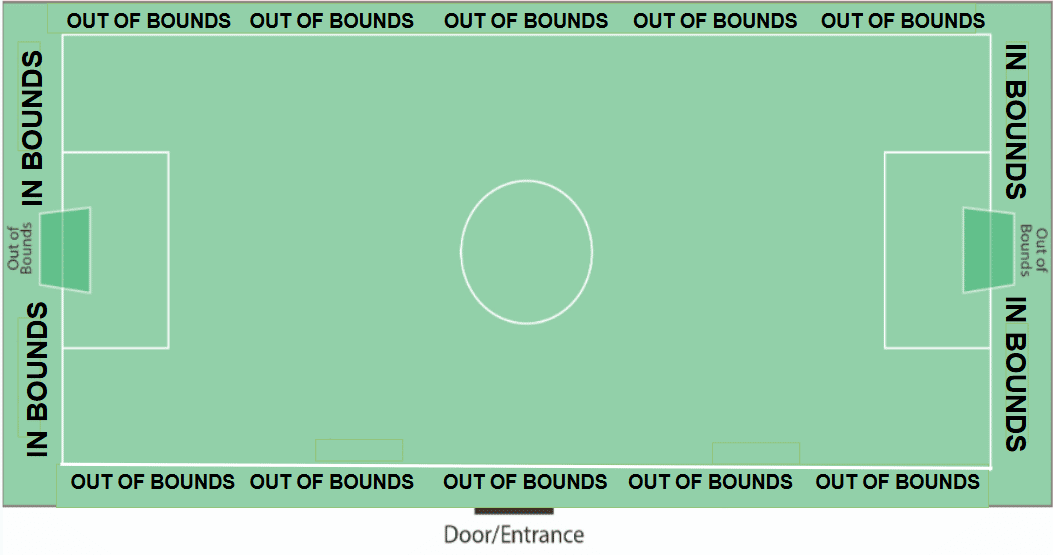
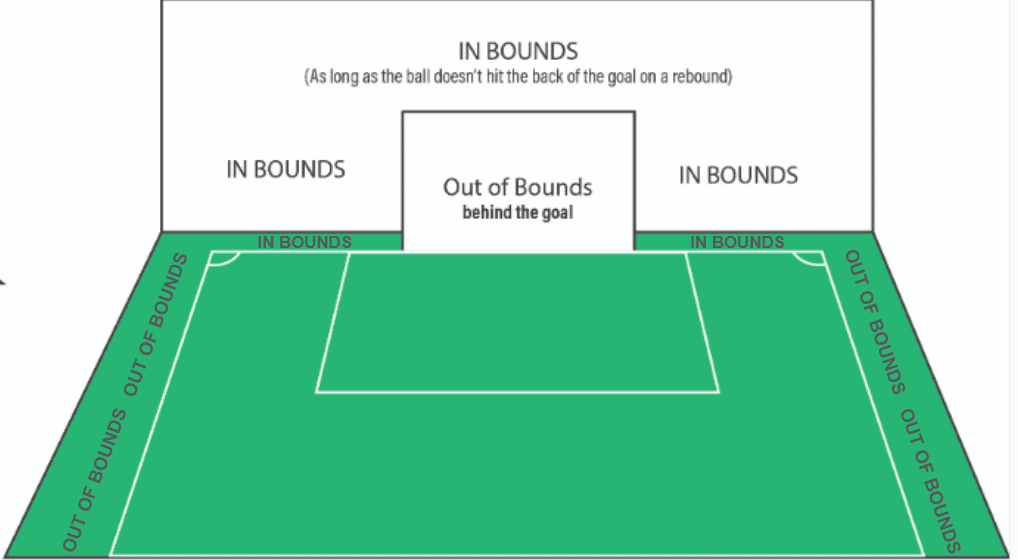
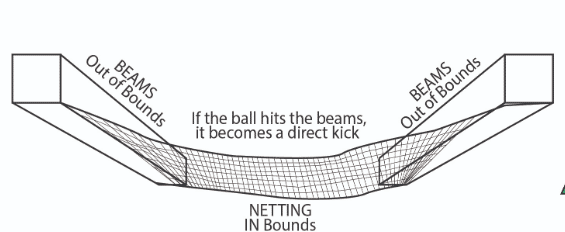
Tap a diagram to open it full size.
Goalies may not pick up a pass directly passed to them by a teammate. Deflections and passes not intended (in the opinion of the referee) for the goalkeeper by the same team (that are not deflected) may be picked up. Goalkeepers have a maximum of 6 seconds to release the ball from their hands. Once the ball is released from the goalkeeper’s hands the ball must leave the penalty area and touch at least one other player before the keeper may pick it up again.
The restart for either of the above infractions results in a direct kick at the top of the imaginary arc (about 2 yards outside of the box). Defenders may be inside the penalty area as long as they are 5 yards away from the ball.
Goalkeepers are the only players that may slide tackle (within their own penalty area only).
The penalty area extends behind the goal following the lines for the sides of the existing penalty area. The goalkeeper may pick up the ball in this area and fouls in this area are treated as if they are inside the penalty area.
A penalty kick is awarded for any penal foul in the team's own penalty area (infractions involving a goalie illegally using his/her hands in his/her penalty area, taking more than 6 seconds, or other non-penal fouls are not included). Penalty kicks are taken 8 yards from the goal line. All players besides the goalkeeper must stand behind the ball and may not enter the penalty area until the ball is touched. A missed penalty shot is a live ball.
There is not a semi circle or arc painted at the top of the penalty area, so players must move to give the shooter an unobstructed path to the ball on a penalty kick. Placement of restarts for goalkeeper infractions is two yards from the top of the penalty area.
Being competitive on the field is applauded & encouraged in all of our leagues! It is also important to understand that there is a fine line between being competitive & being unsportsmanlike. All players and referees should treat one another with respect on the field & after the game. Everyone has to go to work tomorrow, so please keep safety & sportsmanship in mind out there!
Every individual participating in a Players Sport & Social Group program may compete as a member of the gender that they identify with, regardless of their gender at birth. We expect all players to be respectful and honor the spirit of this policy. We are LGBTQIA+ friendly (Lesbian, Gay, Bisexual, Transgender, Queer, Questioning, Intersex, Asexual and other sexualities and gender identities/expressions).
We have found that open communication between teams is super helpful. If there is a situation that may raise some questions from opposing teams, captains are encouraged to have a quick conversation with our umpire/official before the game to ensure everyone is on the same page. At the end of the day, inclusivity is key.
Each game will consist of two 22 minute halves with a running clock.
For coed leagues, each team shall field 5 players, with a minimum of 2 females. If a team does not have 2 females, it may play with 1 female and 3 males. The minimum number of players needed to play a game is 4 (minimum 1 female). Men’s teams may play with a minimum of 4 players for an official game.
Teams may substitute "on the fly" at any point during the game. A player entering the game may not step onto the field until the player he/she is replacing is IMMEDIATELY in front of the bench area. Players must enter and exit the field from their bench area.
There are no designated goalkeepers. Any player (and any number of players) may guard the goal at any time. (See Hand Ball in the Penalty Area below for hand ball fouls committed by players guarding the goal.)
Every surface on the field is in play. Goals can be scored on deflections off a wall. The ball is only out of play when it comes to rest in one of the corners behind the boards, deflects off of the ceiling, or leaves the field of play and does not return. In these instances, a goal kick, kick-in, or corner kick will be awarded.
If a defensive player moves the net, intentionally or unintentionally, the referee may award a goal if he/she judges that a goal would have been scored had the net not been moved. If a defensive player intentionally moves the net in anticipation of a shot that does not make it to the goal, the referee may award a penalty kick.
In the interest of keeping the game moving, players may play a ball out from behind the net. Opposing players may not immediately defend a player who is trying to play a ball out from behind the net. Any dangerous play, blindly kicking at the ball, etc. will result in a goal kick or corner kick.
A defending player may not intentionally place the ball behind the net. If this is done, a corner kick will be awarded. Players are urged to use common sense and courtesy in these situations.
If a defensive player in the goal mouth (WCF or Clemente) is called for a hand ball, a penalty kick is awarded. If the referee deems that the action was intentional to stop a clear scoring chance, the player can be yellow or red carded.
A penalty kick consists of a shot on an empty net from 8 yards out. There can be no attempt to intercept a penalty shot. All players must stand behind the shooter and may not enter the shooting area until the ball has crossed the goal line or contacted a post. A missed penalty shot is a live ball.
Being competitive on the field is applauded & encouraged in all of our leagues! It is also important to understand that there is a fine line between being competitive & being unsportsmanlike. All players and referees should treat one another with respect on the field & after the game. Everyone has to go to work tomorrow, so please keep safety & sportsmanship in mind out there!
Every individual participating in a Players Sport & Social Group program may compete as a member of the gender that they identify with, regardless of their gender at birth. We expect all players to be respectful and honor the spirit of this policy. We are LGBTQIA+ friendly (Lesbian, Gay, Bisexual, Transgender, Queer, Questioning, Intersex, Asexual and other sexualities and gender identities/expressions).
We have found that open communication between teams is super helpful. If there is a situation that may raise some questions from opposing teams, captains are encouraged to have a quick conversation with our umpire/official before the game to ensure everyone is on the same page. At the end of the day, inclusivity is key.
Any rule not addressed in this section is governed by the outdoor 6v6 rules (see the 7v7 & 6v6 tab).
For coed leagues, each team shall field 5 players, with a minimum of 2 females. If a team does not have 2 females, it may play with 1 female and 3 male players. The minimum number of players needed to play a game is 4 (minimum 1 female). Men's teams may play with a minimum of 4 total players.
Flying substitution: all players but the goalkeeper can enter and leave as they please. Goalkeeper substitutions can only be made when the ball is out of play and with a referee's consent.
Penal fouls inside the penalty area result in a penalty kick to be taken 8 yards from the goal line. All players other than the goalkeeper must be behind the ball until it is kicked.
Being competitive on the field is applauded & encouraged in all of our leagues! It is also important to understand that there is a fine line between being competitive & being unsportsmanlike. All players and referees should treat one another with respect on the field & after the game. Everyone has to go to work tomorrow, so please keep safety & sportsmanship in mind out there!
Every individual participating in a Players Sport & Social Group program may compete as a member of the gender that they identify with, regardless of their gender at birth. We expect all players to be respectful and honor the spirit of this policy. We are LGBTQIA+ friendly (Lesbian, Gay, Bisexual, Transgender, Queer, Questioning, Intersex, Asexual and other sexualities and gender identities/expressions).
We have found that open communication between teams is super helpful. If there is a situation that may raise some questions from opposing teams, captains are encouraged to have a quick conversation with our umpire/official before the game to ensure everyone is on the same page. At the end of the day, inclusivity is key.
Any of the above rules are subject to change at any time without notice at the discretion of Players Sport & Social Group.


I have really enjoyed my experience so far, it's a super fun way to meet new people in the city! Definitely recommend for anyone new to Chicago or just looking to meet people in general!!
I’ve been playing in Players volleyball tournaments and leagues for the last 10 years and am always so impressed. They are beyond organized with their tournaments, are super responsive and attract great competition. 11/10 stars!!
Great people and great vibes. If you're looking to get out and meet some people while having fun then Players Sports is for you. There are leagues and tournaments for a bunch of different sports. They run them for all skill levels and you get cool shirts if you win. Also a lot of free promos - they give out a lot of energy drinks and other stuff. Overall, very fun and very friendly environment.
Players is awesome for adult sports leagues! Something for everyone and always a great time! Always meeting new people and joining in on different events.
I have been playing with Players Sports Volleyball leagues and tournaments for years now and love it! They always provide a competitive atmosphere while displaying sportsmanship throughout the entire time. I have signed up with teams, I have also signed up by myself and been placed on a team which have turned into friendships and continued participation. I highly recommend Players Sport Social for competitive volleyball and all sports!
To complete the process, remove the app from your Facebook settings.
Feel free to try again, and be sure to grant the requested privileges.
Feel free to try again, and be sure to grant the requested privileges.
Feel free to try again or contact us for assitance.
| Name | Username | Last Login |
|---|
These are the accounts with the same email address as your Facebook account ().
If you'd like to use a different account, log into that account using your email (or username) and password, then connect your Facebook account from your Player Page.
*NOTE: In order to keep your site and player info safe, Admin and Staff accounts cannot be linked to Facebook.